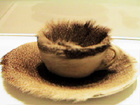
The exact date seems to be uncertain, but at some point in January 1960 John Cage actually appeared on the TV game show, I've Got a Secret. Thanks to Tom Devaney for pointing this out to me, and to WFMU for capturing the video (from re-runs?). Click here to view the video (on YouTube - where it's been viewed a remarkable 110,000 times as of this writing and has received a 4-out-of-5 star rating, and 346 comments from viewers).
Cage is permitted to perform "Water Work" in its entirety. While there are a number of condescending comments about Cage's music, on the whole the show treats him with respect. They even decided (spontaneously?) to give up the usual game format (four panelists try to guess what Cage does).
The composition was meant to include the sounds of five radios playing, but you won't hear them in this performance. It seems that two unions could not agree on which of them was supposed to plug the radios into the wall sockets, and of course it was forbidden, in a TV studio, for Cage or any other non-union person to plug them in. So no radios.


 Is '60 the moment when the end of the end of the Old Left had been reached and the New Left began to emerge? Is it the final ascendancy, in certain scenes at least, of poetic postmodernity? Surely the publication of Donald Allen's The New American Poetry that year suggests this, but then again--once again--we look back on "New" here and see continuity. The rhetoric of the Kennedy-Nixon contest made much less of a dent than everyone (at the time as well as since) claimed, so one wonders why were such great claims made?
  Had we come to expect "1960" to be truly ubiquitously modern in a way that the 1950s really were not--not quite? And what specifically does "modern" mean in the Kennedyesque talk then and now about the torch being passed to a new generation, etc.? The First Lady really meant "modernist" when Camelotians said "modern." What about the others across the new young cultural leadership? I've been surprised by how frequently the
  "Beat movement" was covered in 1960 in the mainstream press. I was expecting a fair measure but I've found tonnage. 1960 was the year when the figure of the beat was beginning to find acceptance, although still 80% of these stories are mocking, rebels-without-cause condescension. For anyone whose analysis made an impact nationally, do these antipolitical adolescents count as part of the "new young cultural leadership"? No, but rather than the two being opposites, they fall along a Continuum of the New American. Now that's a change for '60.