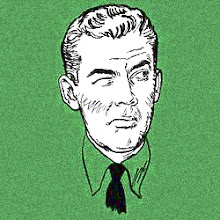
Stuart Preston, art critic.
This entry wanders a bit, first dealing with a show featuring geometric and non-representational paintings, but then moves to the state of surrealism in the U.S. in 1960. Before I wander, let's begin with a deceptively simple summary statement about surrealism written for Poetry in 1960 by the long-time Bennington College teacher and critic of French modern lit, Wallace Fowlie:
Poetry is the power to create, to confer a new meaning on an object... The surrealist contribution to the theory of poetics ranks high today among the movement's major contributions. The poet, they say, borrows nothing that is foreign or unfamiliar to himself. He takes back what was his to begin with--those things, precisely, in which he recognizes himself... They spoke constantly of the state of poetry as something that is lived and thought of as an interrogation, as quasi-discovery.
Okay, let's go elsewhere first....to the Galerie Chalette, where in the spring there was a compehensive exhibition entitled "Construction and Geometry in Painting--from Malevitch to 'Tomorrow.'" In other words, a show of non-objective paintings. A typical canvas was Victor Vasarely's "Citra" (1955-59): the canvas is divided in half, top background dark, bottom light. Shapes (squares, diamonds, bold polygons of all kinds) are arranged together in color-relief against the background, right triangle poking out at exactly 12, 3, 6 and 9 o'clock, like a spiny, squat top.
Preston* noted that these works "sacrifice too many human impulses in achieving their ends and can only be considered completely satisfactory works or art in a limited sense." The paintings here, he said, "exist[...] on their own without need of literary or emotional occasions."
Since I'm interested these days in the situation and reputation of surrealism in 1960, I am intrigued by the way Preston manages the transition between sections of his Times review - moving from one exhibit to the next. Here he's moving from the non-objective show to Kurt Seligman's recent paintings which were then showing at Fine Arts Associates. No need of a transition, of course; readers used to the "what's going on at the galleries" round-up can shift gears quickly. But Preston writes this:
The 'pure' basis of geometrical art is absolutely repudiated in surrealism's pact with the unconscious....
The main difference between Vasarely's inhuman non-literariness and Seligman's "dense thickets of myth and fantasy" is that the former doesn't partake of mystery in the least and the latter was...well here's Preston's awkward term that he got passed NYT's editors..."one of modern art's foremost mystifactors."
The key for Preston is the imagination. Non-objective art doesn't have it, surrealism does.
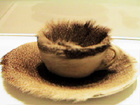
Surrealism in the U.S. seems to have had three big moments in 1960: (1) Wallace Fowlie's essay (quoted at the outset of this entry), "Surrealism in 1960: A Backward Glance," published in Poetry in March issue; (2) the publication of Anna Balakian's important book, Surrealism: The road to the Absolute (Noonday--reviewed variously in April); and (3) a show at D'Arcy Galleries featuring 58 surrealist painters and sculptors put together by Marcel Duchamp and Maurice Bonnefoy (owner of the gallery) at the end of November. (I'm focused on American happenings here, so I won't count a fourth big surrealist moment that year. Back in January, in Paris, crowds flocked to the Eighth International Exposition of Surrealism. The theme that year was eroticism. Apparently, though, gallery-goers were not sufficiently shocked. "For the truth is," one critic wrote, "surrealism's erotic symbols and visual jokes [e.g. the fur-lined teacup at New York's Museum of Modern Art show in 1936] have ceased to shock or enrage the bourgeois."***)
 Later entries here will surely return to the three above-mentioned American surrealist moments, but let me add a word here about the Duchamp show. When reviewers showed up at the gallery to find out about the show in advance of the opening, they found Duchamp waiting for the delivery of three live chickens, standing outside 1091 Madison Avenue. The fowl were to participate in the show. (They were set off in a corner near a sign that read "Coin Sale.") A pair of half-burned logs were set neatly on andirons against a wall in which they was no fireplace.
 The premiere was held on Saturday night, November 28. The opening was a benefit for the Damon Runyon Fund for Cancer Research.
The 58 pieces Duchamp and Bonnefoy chose were meant to be more representative of the surrealist movement "from 1913 to today." In one gallery five electric clocks hung from the ceiling. There was also "an ancient typewriter" and an old time clock with which guests at the premiere punched their invitations upon entering. There was a length of garden hose, to be spread around "as a good-natured hazard." A toy electric train circled a track set up in one of the gallery's Madison Avenue windows, pulling cards marked with the names of the surrealists in the show.
My favorite part of the exhibit: From concealed speakers set up around the galleries, came a recording...of a child's piano practice, mistakes and all.**
 Another report**** says that the show was organized by Andre Breton, who of course wrote the first surrealist manifesto in 1924 and still by then presided over surrealism's followers in Paris.
Recent painters whom we don't normally call surrealist were included in the show: Jasper Johns, Robert Rauschenberg. The New Yorker***** critic said somewhat oddly of Rauschenberg: "surely a Dadaist, if I ever saw one."
Generally critics in 1960 either gloated over the fact that surrealism no longer shocked the middle classes or tsk-tsk'ed that "what once seemed sick now seems strangely sane."
What interests me about the state of surrealism in 1960 is the conclusion drawn with such certainty by the New Yorker critic: "[I]t might be said that instead of Surrealism's taking over America, America took over the Surrealists."
* "Questions of Meaning," NYT, Apr. 10, 1960, p. X13. ** NYT, Nov. 28, 1960, p. 36. *** Newsweek, Jan. 18, 1960, pp. 87-88. **** Time, Dec. 12, 1960, p. 81. ***** New Yorker, Dec. 10, 1960, p. 200.


 Is '60 the moment when the end of the end of the Old Left had been reached and the New Left began to emerge? Is it the final ascendancy, in certain scenes at least, of poetic postmodernity? Surely the publication of Donald Allen's The New American Poetry that year suggests this, but then again--once again--we look back on "New" here and see continuity. The rhetoric of the Kennedy-Nixon contest made much less of a dent than everyone (at the time as well as since) claimed, so one wonders why were such great claims made?
  Had we come to expect "1960" to be truly ubiquitously modern in a way that the 1950s really were not--not quite? And what specifically does "modern" mean in the Kennedyesque talk then and now about the torch being passed to a new generation, etc.? The First Lady really meant "modernist" when Camelotians said "modern." What about the others across the new young cultural leadership? I've been surprised by how frequently the
  "Beat movement" was covered in 1960 in the mainstream press. I was expecting a fair measure but I've found tonnage. 1960 was the year when the figure of the beat was beginning to find acceptance, although still 80% of these stories are mocking, rebels-without-cause condescension. For anyone whose analysis made an impact nationally, do these antipolitical adolescents count as part of the "new young cultural leadership"? No, but rather than the two being opposites, they fall along a Continuum of the New American. Now that's a change for '60.