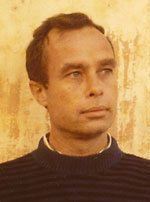
 Jacket in 2004 published six poems from 1960 by Landis Everson.
 Ben Mazer added this note: "These six poems are from two sequences which Landis Everson wrote while participating in a weekly poetry group with his friends Jack Spicer and Robin Blaser in San Francisco in 1960. A mimeograph booklet of Postcard from Eden was privately circulated by James Herndon in an edition of a handful of copies, issued simultaneously with the mimeograph booklet of Spicer’s Homage to Creeley around February of 1960. John Ashbery published selections from “The Little Ghosts I Played With” in Locus Solus III–IV (winter 1962). The selections excerpted here did not appear in Locus Solus."
Each native grinned down at me, white teeth,
Black faces. “Come,” I said, “We can be friends.”
But they jabbed at me with pink fingers,
Played lovingly with my hair, caressed
My arms and my toes and stared
Excitedly at my eyes.
Everson was born in 1926. In the late 1940s he was a member of the Berkeley Renaissance along with his friends Robert Duncan, Jack Spicer and Robin Blaser. He was the inaugural recipient of the Emily Dickinson Award from the Poetry Foundation.
Everson was born and grew up in Coronado, California which at that time was still an island, connected to San Diego by a ferry. He attended the University of Redlands in Southern California. Everson, Spicer and Blaser participated in a poetry group that met on Sundays up until 1960. Duncan was excluded from this group. Around this time James Herndon published Everson's pamphlet Postcardu from Eden. His work also appeared in John Ashbery & Harry Mathews's Locus Solus in 1962. At some point Everson stopped writing poetry. The Boston poet Ben Mazer came across Everson's work while he was putting together a special feature on the Berkeley Renaissance for Fulcrum. Mazer's interest sparked Everson to start writing poetry again.


 Is '60 the moment when the end of the end of the Old Left had been reached and the New Left began to emerge? Is it the final ascendancy, in certain scenes at least, of poetic postmodernity? Surely the publication of Donald Allen's The New American Poetry that year suggests this, but then again--once again--we look back on "New" here and see continuity. The rhetoric of the Kennedy-Nixon contest made much less of a dent than everyone (at the time as well as since) claimed, so one wonders why were such great claims made?
  Had we come to expect "1960" to be truly ubiquitously modern in a way that the 1950s really were not--not quite? And what specifically does "modern" mean in the Kennedyesque talk then and now about the torch being passed to a new generation, etc.? The First Lady really meant "modernist" when Camelotians said "modern." What about the others across the new young cultural leadership? I've been surprised by how frequently the
  "Beat movement" was covered in 1960 in the mainstream press. I was expecting a fair measure but I've found tonnage. 1960 was the year when the figure of the beat was beginning to find acceptance, although still 80% of these stories are mocking, rebels-without-cause condescension. For anyone whose analysis made an impact nationally, do these antipolitical adolescents count as part of the "new young cultural leadership"? No, but rather than the two being opposites, they fall along a Continuum of the New American. Now that's a change for '60.